9 Genius Ways to Make $500-$3000/Month From Your Backyard Garden (Even in a Small Space!)
Your garden isn’t just pretty to look at. It’s real estate that could be generating serious side income while you sleep. I’m not talking about pocket change from a few tomatoes at a yard sale. I’m talking about $500 to $3,000 per month in actual profit—enough to cover your mortgage, fund a vacation, or finally build that emergency fund.
The best part? You don’t need acres of land, a fancy greenhouse, or a degree in agriculture. Just a willingness to get your hands dirty and think strategically about what you grow.
Why Your Garden Is Actually a Goldmine (And Why Now Is the Perfect Time)
Three massive trends are colliding right now that make garden-based income more profitable than ever:
The “know your farmer” movement – People will pay 2-3x more for produce when they know exactly where it came from. Your neighbor values your pesticide-free tomatoes way more than the ones shipped 1,500 miles to Whole Foods.
The artisan economy – Etsy sellers are making six figures. Farmers’ market vendors are booked solid. People crave authentic, handmade, small-batch products—all things you can create in your garden.
The wellness explosion – Natural skincare, organic herbs, raw honey, and chemical-free produce aren’t “hippie stuff” anymore. They’re mainstream, and customers actively seek them out.
Translation: What you grow has never been more valuable.
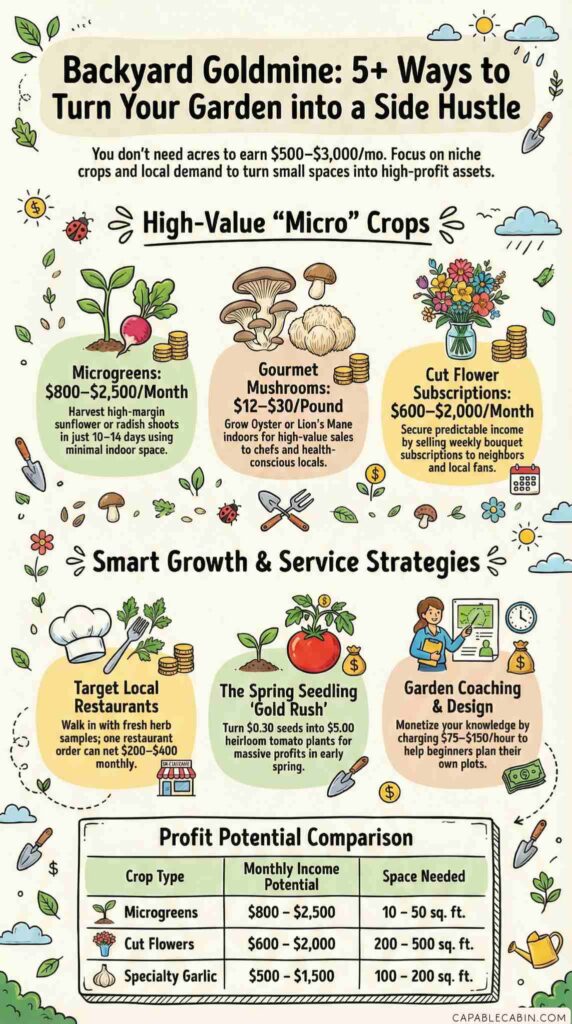
1. Microgreens: The Fast-Growing Crop Restaurants Can’t Get Enough Of
Income potential: $800-$2,500/month
Space needed: 10-50 square feet
Startup cost: $200-$500
Here’s something most gardeners don’t know: restaurants will pay premium prices for microgreens they simply can’t find at regular suppliers.
Sunflower microgreens wholesale for $30-$50 per pound to restaurants. A single 10×20-inch tray produces about 1.5 pounds in just 10-14 days. That’s $45-$75 worth of produce from a space smaller than a coffee table, harvested every two weeks.
The math that makes this work:
- Start with 10 trays in rotation
- Each tray harvests every 2 weeks = roughly 2 harvests per month
- 1.5 lbs per tray × $40/lb average = $60 per harvest
- 10 trays × 2 harvests × $60 = $1,200/month potential
- Time investment: 5-10 hours weekly (watering, planting, harvesting, delivery)
What actually sells: Restaurants pay top dollar for sunflower shoots, pea shoots, radish, and arugula microgreens. Skip the common stuff like basic lettuce mix. Focus on bold flavors and interesting textures that chefs can’t get anywhere else—the kind that make dishes Instagram-worthy.
How to start small: Begin with 5 trays of sunflower microgreens. Contact 3-5 local restaurants (not chains—independent places with actual chefs). Offer free samples with a simple pitch: “I grow hyperlocal microgreens, harvested the morning of delivery. Would you like to try some?” Once you have 2-3 regular customers ordering weekly, scale up gradually.
The reality check: Microgreens require consistency. Miss a delivery, and restaurants move on. But show up every week with quality product, and you’ll have reliable income that builds month after month.
2. Cut Flower Subscription Boxes: Recurring Revenue While You Garden
Income potential: $600-$2,000/month
Space needed: 200-500 square feet
Startup cost: $150-$400
Subscription boxes are genius because they create a predictable income. Instead of hoping someone buys flowers at the farmers market, you have 20-50 people pre-paying you monthly for fresh bouquets.
I ran the numbers when local florist shops charge $45-$65 for arrangements: If you charge $35/week for a beautiful seasonal bouquet and land just 15 subscribers, that’s $525/week or $2,100/month.
The flowers that actually make money:
- Zinnias (blooms for months, zero-effort)
- Sunflowers (Instagram catnip, everyone wants them)
- Dahlias (premium pricing, people go crazy for them)
- Celosia (lasts 2 weeks in a vase)
- Snapdragons (spring gold mine)
The secret sauce: Plant succession crops every 2 weeks so you always have blooms. Most failed flower businesses plant everything at once, get one big harvest, then have nothing for 6 weeks.
Real talk about pricing: Don’t underprice yourself trying to compete with grocery store bouquets. You’re not competing with them—you’re offering locally-grown, cut-this-morning, actually-fresh flowers. That’s worth $35-$50, not $12.
How to get your first 10 subscribers: Post beautiful bouquet photos on Facebook community groups and Instagram. Offer “limited spots available – only taking 15 subscribers this season.” Scarcity works.
Pinterest Pin Idea: “How I Make $2,000/Month With a Flower Subscription Box (Free Template Included!)”
3. Gourmet Garlic: The Crop That Sells Itself for $12-$20/Pound
Income potential: $500-$1,500/month (seasonal) Space needed: 100-200 square feet Startup cost: $100-$200
Garlic is absurdly profitable and nobody talks about it. Grocery store garlic goes for $4-$6/pound. Gourmet, locally-grown hardneck varieties? $12-$20/pound at farmers markets, and it flies off the table.
Plant in fall, harvest in summer, cure for 2-4 weeks, then sell all year long. One 100 square foot bed can produce 200-300 bulbs (40-60 pounds). At $15/pound, that’s $600-$900 from one planting.
Why it works: Seed garlic (what you plant) costs $20-$30/pound. Each clove becomes a full bulb. A 1-pound bag has about 8-10 cloves per bulb, so maybe 40-50 cloves. Plant those, get 40-50 new bulbs (roughly 8-10 pounds), sell at $15/pound = $120-$150. Keep your biggest bulbs for next year’s seed, sell the rest.
Varieties people actually want:
- Music (massive bulbs, easy to peel)
- Chesnok Red (beautiful purple, amazing flavor)
- German Extra Hardy (lives up to the name)
- Spanish Roja (gourmet chefs seek this out)
The pricing trick: Sell individual bulbs ($3-$5 each) instead of by the pound. People perceive more value, and you make more per pound.
4. Herb Garden for Restaurants: Weekly Orders = Steady Income
Income potential: $400-$1,200/month
Space needed: 50-150 square feet
Startup cost: $100-$300
One small restaurant using your fresh herbs weekly is worth $200-$400/month. Get 3-4 restaurants, and you have a steady income that doesn’t depend on market weather or weekend sales.
What restaurants actually pay for:
- Basil: $16-$24/pound (they use tons of it)
- Cilantro: $12-$20/pound
- Dill: $18-$28/pound
- Specialty sage: $20-$32/pound
- Edible flowers: $25-$40/ounce (yes, ounce)
A 4×8 raised bed can produce 2-4 pounds of basil weekly during peak season. That’s $32-$96 per week from one bed.
How to actually land restaurant accounts: Don’t email. Walk in Tuesday-Thursday between 2-4pm (slow time) with beautiful samples in hand. Ask for the chef. Say “I grow hyperlocal herbs—harvested this morning. Would you like to try some?” Most will say yes just to taste fresh basil that’s actually flavorful.
The reliability factor: Restaurants care more about reliability than price. If you show up every Tuesday with what they ordered, they’ll keep buying. Miss twice, and they’ll find someone else.
Pinterest Pin Idea: “I Supply 4 Restaurants With Fresh Herbs From My Backyard – Here’s My System”
5. Specialty Culinary Mushrooms: High-Value Crop, Minimal Space
Income potential: $600-$2,000/month
Space needed: 50-150 square feet (indoor)
Startup cost: $300-$800
Oyster mushrooms wholesale for $12-$16/pound and retail for $18-$25/pound. Lion’s mane? $20-$30/pound retail. Shiitake? $16-$22/pound.
A single 5-pound mushroom grow bag produces 2-4 pounds of mushrooms over 2-3 flushes. At $20/pound retail, that’s $40-$80 per $15 bag of substrate.
Why mushrooms are perfect for a side income:
- Grow indoors (basements, garages, spare rooms)
- 4-6 week crop cycle
- Harvest weekly once they start fruiting
- Extremely high perceived value
- Chefs and health-conscious consumers actively seek them
The varieties that sell: Skip regular button mushrooms (cheap commodity). Focus on:
- Oyster mushrooms (easiest, fastest, most reliable)
- Lion’s mane (trending hard, medicinal properties)
- Shiitake (familiar to customers, premium pricing)
How to start: Buy 3-5 ready-to-fruit grow bags online ($20-$30 each). Follow instructions exactly. Harvest, learn the process, then scale up by making your own substrate bags (way cheaper).
Sales strategy: Farmers markets are okay, but direct restaurant sales and CSA add-ons are better. Partner with a vegetable CSA and offer mushrooms as a weekly add-on ($8-$12 per pound, they handle delivery).
6. Garlic Scapes: The Spring Delicacy That’s Pure Profit
Income potential: $300-$800 (seasonal, but worth it)
Space needed: Same as your garlic patch
Startup cost: $0 (if you’re already growing garlic)
If you’re growing hardneck garlic (which you should be, see #3), you’re already sitting on this opportunity.
Garlic scapes are the curly flower stalks you cut off garlic plants in late spring. You’d remove them anyway to help bulbs grow bigger. Instead of composting them, sell them for $8-$15/pound.
The magic: One garlic plant produces one scape. 200 plants = 200 scapes = roughly 8-12 pounds at $10-$12/pound = $80-$144 for something you were going to throw away.
What makes scapes valuable: They’re only available 2-3 weeks per year. Chefs love them (mild garlic flavor, beautiful presentation). Home cooks buy them to make pesto.
How to sell them fast: Post in local Facebook foodie groups: “Fresh garlic scapes available – limited time only, 2 weeks per year!” Create urgency. Bundle them ($5 for a half-pound bundle). They’ll sell out.
7. Heirloom Tomato Seedlings: Spring Gold Rush
Income potential: $800-$2,500 (March-May)
Space needed: 20-50 square feet (with grow lights)
Startup cost: $150-$400
Garden centers sell tomato seedlings for $3-$5 each. Heirloom varieties? $5-$8 each. You can produce them for about $0.30-$0.60 each.
Start 500 seedlings in late winter. Sell 400 at an average of $5 each = $2,000 in revenue. Keep 100 for yourself.
The varieties that sell themselves:
- Cherokee Purple (legendary flavor)
- Brandywine (classic heirloom)
- Black Krim (unique, Instagram-worthy)
- Green Zebra (conversation starter)
- Sungold cherry (candy-sweet, everyone wants it)
Why this works: Most people don’t want to deal with starting seeds. They’ll happily pay $5-$7 for a healthy plant ready to transplant, especially rare varieties they can’t find at Home Depot.
The sales window: March through mid-May in most regions. Set up at farmers’ markets, post on community Facebook groups, and put a sign in your yard. They’ll sell fast.
Pro tip: Offer a “tomato tasting collection” of 6 different heirloom varieties for $30-$35. People love curated bundles.
8. Lavender Products: One Crop, Multiple Revenue Streams
Income potential: $500-$1,800/month (seasonal)
Space needed: 100-300 square feet
Startup cost: $200-$500
Lavender is a money printer disguised as a pretty plant. Here’s why: you harvest once, then create multiple products.
What you can make and sell:
- Fresh lavender bundles: $8-$12 each
- Dried lavender bunches: $10-$15 each
- Lavender sachets: $6-$10 each (costs you $0.50 to make)
- Lavender simple syrup: $12-$16 per bottle
- Lavender-infused honey: $14-$20 per jar
- Lavender essential oil (with distiller): $20-$40 per small bottle
The math: 25 mature lavender plants yield roughly 20-30 pounds of fresh lavender per year. Turn half into bundles ($10 each × 40 bundles = $400), make the rest into sachets and value-added products ($800-$1,200).
What actually sells at markets: Lavender sachets are impulse buys. Price them at $8-$10, make them smell amazing, and stack them beautifully. People buy 2-3 at a time for gifts.
9. Garden Coaching & Design Consultations: Monetize Your Knowledge
Income potential: $400-$2,000/month
Space needed: None
Startup cost: $0-$100
Once you’ve successfully grown any of the above, you have knowledge people will pay for.
Services you can offer:
- Garden design consultations: $75-$150/hour
- Seasonal garden coaching packages: $300-$600 (4 sessions)
- Seed-starting workshops: $35-$50 per person (teach 8-12 people)
- One-day intensive garden planning: $400-$800
Why this is genius: It’s pure profit (no product costs), it positions you as an expert (helps sell your produce), and it’s scalable (group workshops multiply your hourly rate).
How to start: Offer free 30-minute consultations to 3-5 people in exchange for testimonials. Then create a simple service menu and promote it where your customers already are (Facebook groups, Instagram, farmers market signage).
The seasonal package that works: “Spring Garden Kickstart” – Four 1-hour sessions (March, April, May, June) for $400. Help clients plan, plant, troubleshoot, and succeed. Most will hire you again next year.
The Real Secret: Stack Your Income Streams
Here’s what nobody tells you: the magic happens when you combine multiple strategies.
My first year, I grew microgreens for restaurants ($800/month), sold cut flower subscriptions ($400/month), and ran two seed-starting workshops ($600 total). That’s $2,200/month in peak season from my backyard.
Start small, stack smart:
- Month 1-2: Start microgreens or choose one specialty crop
- Month 3-4: Add cut flowers or seedlings (whatever suits your season)
- Month 5-6: Launch one value-added product (jams, dried herbs, sachets)
- Month 7-8: Offer your first workshop or consultation
Getting Started This Week (Your 7-Day Action Plan)
Stop planning and start profiting. Here’s what to do in the next 7 days:
Day 1-2: Choose ONE idea from this list based on your space, season, and interests. Don’t try to do everything.
Day 3-4: Research your local market. Visit farmers’ markets. Check Facebook Marketplace. See what’s selling and at what prices.
Day 5: Buy your supplies. Order seeds/plants/materials. Don’t overthink it.
Day 6-7: Plant, prep, or create your first batch. Take photos for marketing.
Week 2: Make your first sale. Test pricing. Get feedback.
Then refine and scale.
The Mistakes That Kill Garden Income (And How to Avoid Them)
Mistake #1: Underpricing because you feel guilty: Your tomatoes aren’t competing with grocery store tomatoes. They’re competing with the restaurant down the street. Price accordingly.
Mistake #2: Growing what you like instead of what sells: I love Brussels sprouts. Nobody buys them at my market. I grow microgreens now.
Mistake #3: Waiting until everything is perfect: Your first batch will be imperfect. Sell it anyway. You’ll learn faster from real customers than from YouTube videos.
Mistake #4: Not marketing consistently: Post 3-4 times weekly on social media. Show behind-the-scenes. Share harvest photos. Build anticipation. People buy from people they know.
Mistake #5: Trying to do too much in year one: Master one income stream. Then add another. Spreading yourself thin kills profits and joy.
Your Garden, Your Income, Your Timeline
You don’t need to quit your job or invest thousands of dollars. You need a small space, a solid plan, and consistent action.
Start with microgreens this month. Add flower subscriptions in spring. Test specialty garlic next fall. Before you know it, you’ll be pulling real income from that patch of dirt you used to just mow.
The garden is already there. The market is already hungry for what you can grow. The only question is: when will you start?